Smoke Density VS Heat Release: Two measurements, Two distinct fire hazards
Editorial Summary

In fire safety testing, smoke density and heat release are two critical but fundamentally different measurements, each representing a distinct fire hazard. Heat release rate (HRR) determines how quickly a fire grows and spreads, while smoke density measures how rapidly visibility is lost and toxic gases accumulate—impacting evacuation and survivability.
Both parameters are independently mandatory under standards like EN 45545-2, as a material can perform well in one and fail in the other. A product with low heat release may still generate dense, toxic smoke, while a low-smoke material may contribute to rapid fire growth. There is no trade-off—both must pass for compliance.
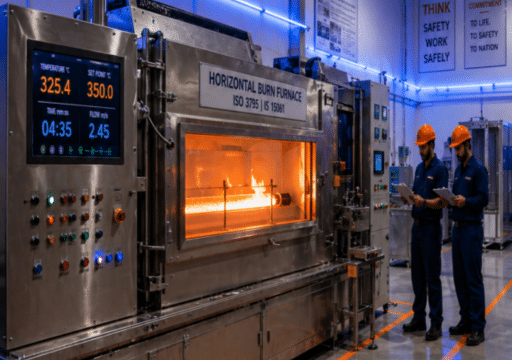
Heat release is measured using the cone calorimeter (ISO 5660-1), evaluating metrics like FIGRA and total heat release, which define fire growth and intensity. Smoke density is assessed using the smoke chamber (ISO 5659-2), focusing on visibility loss and smoke accumulation through parameters like optical density and VOF4.
The document highlights that misunderstanding this distinction is a common cause of compliance failure. Effective material selection requires a balanced approach, ensuring both low heat contribution and controlled smoke generation. Advanced testing and integrated analysis are essential to achieve reliable, real-world fire performance.
See the full editorial in the PDF download below.