The Fire Performance of a Building Depends on More Than Its Structure
When we talk about fire safety in buildings, the conversation usually starts and ends with the frame: concrete, steel, columns, beams. A sturdy structure feels reassuring. But in a real fire, a building is not judged by its skeleton alone. It is judged by everything it is made of, everything it is fitted with, and how it all behaves together at elevated temperatures.
At Prospec, we test construction materials and building products every day. What we see in the lab is simple and consistent: a strong structure does not guarantee a fire-safe building.
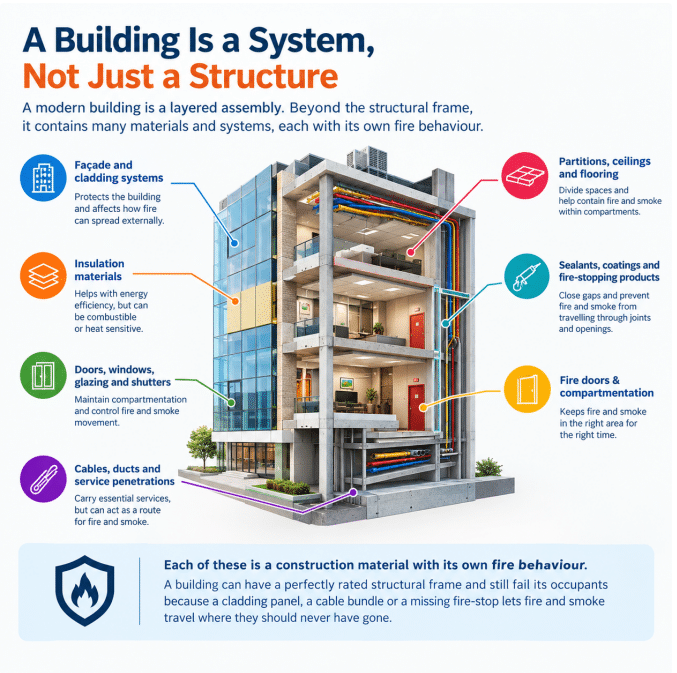
A Building Is a System, Not Just a Structure
A modern building is a layered assembly. Beyond the structural frame, it contains:
- Facade and cladding systems
- Insulation materials
- Doors, windows, glazing and shutters
- Partitions, ceilings and flooring
- Cables, ducts and service penetrations
- Sealants, coatings and fire-stopping products
Each of these is a construction material with its own fire behaviour. Some resist heat. Some feed the flames. Some release dense smoke or toxic gases long before the structure is threatened. A building can have a perfectly rated structural frame and still fail its occupants because a cladding panel, a cable bundle or a missing fire-stop let fire and smoke travel where they should never have gone.
Two Questions Every Material Must Answer
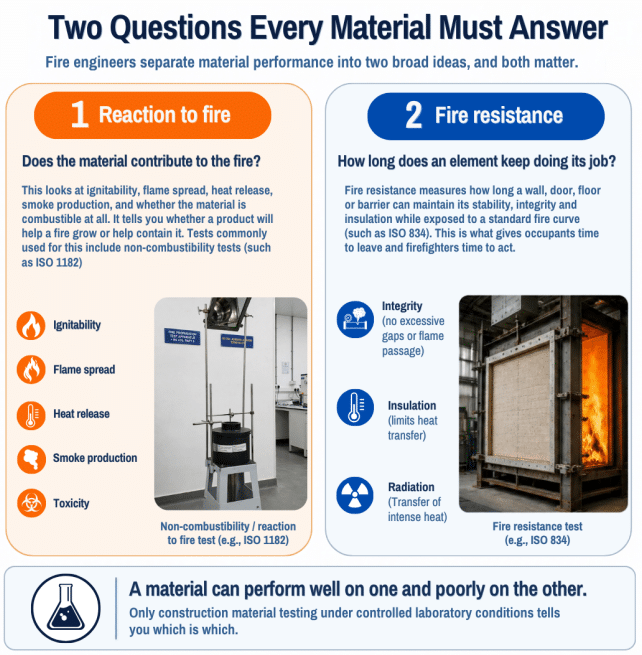
Fire engineers separate material performance into two broad ideas, and both matter.
1. Reaction to fire: does the material contribute to the fire? This looks at ignitability, flame spread, heat release, smoke production, and the toxicity of the fumes it releases. It tells you whether a product will help a fire grow or help contain it. Tests commonly used for this include EN ISO 1182 (non-combustibility), EN ISO 1716 (heat of combustion), EN 13823 SBI (heat release, smoke and flaming droplets) and EN ISO 11925-2 (ignitability), along with ISO 5659-2 and ISO 19702 for smoke and toxic gases. Results feed classification systems like EN 13501-1.
2. Fire resistance: how long does an element keep doing its job? Fire resistance measures how long a wall, door, floor or barrier can maintain its integrity, insulation and radiation while exposed to a standard fire curve (such as ISO 834). This is what gives occupants time to leave and firefighters time to act.
A material can perform well on one and poorly on the other. Only construction material testing under controlled laboratory conditions tells you which is which.
Where Fire Spreads When Structure Holds
Some of the most serious building fires in recent decades did not begin with structural collapse. They spread through façades, voids, shafts and service openings, driven by materials that were never properly tested for their intended use, or were used in combinations that were never tested at all.
Three gaps appear again and again:
Untested combinations. A panel, an insulation layer and a fixing system may each look acceptable on paper, yet behave very differently as a complete assembly.
Compartmentation failures. Fire resistance depends on keeping fire inside its compartment. Unsealed penetrations, poorly installed fire doors and gaps at joints undo the work of the rated wall around them.
Paper compliance. A datasheet is not a test report. Claims about fire rating need to be backed by results from an accredited laboratory, for the product as it will actually be installed.
Why Construction Testing Belongs at the Start, Not the End
Too often, construction testing is treated as a final box to tick before handover. By then, a failed result means redesign, replacement, delay and cost, or worse, a compromise.
Testing early changes the equation:
- Better material selection. Compare options on verified performance, not marketing claims.
- Smoother approvals. Test evidence supports regulatory submissions and compliance with the National Building Code of India (Part 4: Fire and Life Safety) and applicable BIS standards.
- Stronger trust. Developers, architects, contractors, and manufacturers can stand behind what they specify and supply.
What Better Fire Safety Looks Like
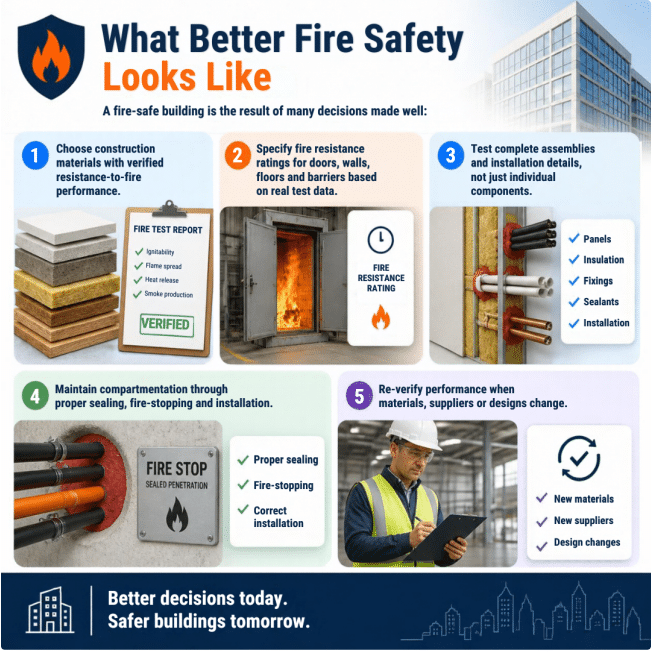
A fire-safe building is the result of many decisions made well:
- Choose construction materials with verified resistance-to-fire performance.
- Specify fire resistance ratings for doors, walls, floors, and barriers based on real test data.
- Test complete assemblies and installation details, not just individual components.
- Maintain compartmentation through proper sealing, fire-stopping and installation.
- Re-verify performance when materials, suppliers or designs change.
The Bottom Line
Structure keeps a building standing. Materials, assemblies and details decide how a fire starts, spreads and ends. Fire performance is earned through evidence, and evidence comes from testing.
At Prospec Test Hub, we help manufacturers, builders, architects and consultants understand exactly how their products behave in fire, so that safety is verified long before it is ever put to the test for real.
Planning to specify or supply a new building product?
Talk to our team about construction material testing, fire resistance testing and compliance support.
Test early. Build with confidence.